MOP: Teaching Every Field Engineer to Repair Like the Best One
Updated: Sep 2
Replacing a text-based fault repair guide with short, expert-recorded videos. This was one of the priorities from the Airtel Business ecosystem roadmap.
My role: Design Lead, from field research to shipped design
The Challenge
The business case started with a churn problem.
Around 1,800 enterprise connections were at risk every year because the same faults kept coming back. About 10,000 connections generated 15,000 repeat complaints between them.
The main cause was poor resolution quality. This came down to three problems:
There was no standard way to guide engineers through a repair
There was no way to verify that a job was done correctly
Best practices lived with individual engineers instead of being documented and shared

The root-cause chain, built from field interviews
At the field engineer level, this showed up as one repeated problem:
A lot of time was spent figuring out what was wrong before the repair could even start.
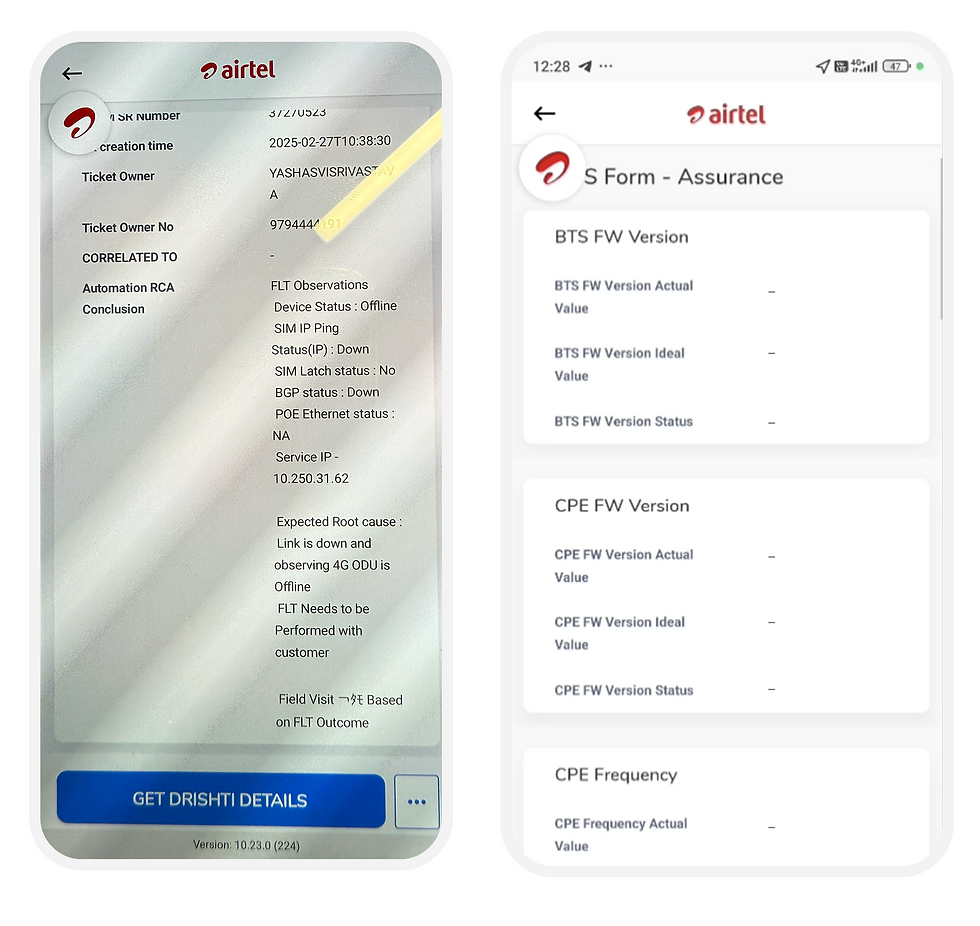
The App Field Engineers were using

A customer's server room
I traced this back to three issues through direct ticket shadowing. On one call at a bank branch in Gurgaon, the fault was a simple ODU alignment issue at the customer’s end.
On another call at a different bank branch that same week, the fault was at the BTS end. The engineer only needed to reboot the system and replace a cable.
The problem was that engineers had no information upfront to tell them what kind of fault they were walking into. They had to diagnose the location and cause from scratch every time. The diagnostic data made this worse.
The check that could confirm the fault only ran after the engineer closed the ticket. It did not run before or during the repair. So the same tool that could have helped prevent the guesswork was only being used after the work was done.
Without this information or a standard process, engineers relied on what experienced people usually rely on under pressure: memory and instinct instead of a repeatable process.
My Role
This was one of the priorities from the Airtel Business ecosystem roadmap: the “MOP for Assurance”.
I led the initiative solo. I shadowed a field engineer and a technician on live tickets to understand the work firsthand.
I then designed the framework end to end, from field research to the final product.
The Core Bet: Video Over Text
A text-based MOP already existed, but it was not working. The problem was not the content. It assumed that every field engineer was comfortable reading detailed technical instructions in English. A checklist only helps if an engineer can read and understand it quickly while working at a customer site.
My hypothesis was simple: a short video of an expert performing the repair would work better than text. An engineer does not need fluent English to watch someone align an ODU and follow the same steps. Video could also make training faster and easier to do on the job, without needing a formal training session. This was a hypothesis, not a certainty. So we tested it through a pilot before taking it further.
Making the Expert Trustworthy
“Follow the expert” only works if the expert is actually right.
The engineers selected for the videos:
Were senior field engineers
Had low repeat-fault rates on their past tickets
Were independently recommended by circle and area management
The goal was to capture a better repair method, not just a confident explanation.
The videos were designed to be short and practical:
5 to 8 seconds long
Compressed for low data usage
Cached for offline playback
Auto-looped
Played on mute
Some of this was because these repairs often happen at sites with poor connectivity.
There was also a practical issue with battery life. Engineers I shadowed were already recharging their phones two or three times a day while using the existing app.
A large, uncompressed video library would have made this worse.
Short and lightweight was not a nice-to-have. It was necessary for the solution to work in the field.

Complete summary of site location - easy to scan

Issue detection

MOP to be followed step-by-step
Rollout & Impact
We piloted the solution before committing to a wider rollout. The hypothesis needed to be tested, not just believed.
There was some resistance at first. Field engineers had their own methods based on years of experience. A new app-based process also adds friction, even when the solution is good.
The pilot showed that the videos saved time. Engineers could see the repair being done instead of working through unclear or late information. This reduced back-and-forth and repeated diagnosis.
The wider rollout delivered roughly ₹9 crore a year in savings by preventing repeat faults from turning into churn.
It also reduced repeat complaints by about 17%, against our benchmark of ~30%.
That is meaningful progress, but it did not close the entire gap identified in the research. The remaining gap is still active work. Resolution time and first-time-right resolution also improved, but I have not included specific numbers because I could not defend them precisely.


