Family Mode & Travel Mode
Designing Airtel around real-life situations, not just products
72% of power-user transactions are already family-led · ~₹6 Cr/month incremental revenue from Travel Mode · ~1 lakh daily visitors to Travel Mode
The Next Gen Airtel App redesign was built around a broader idea: the app should adapt to the context customers are in, rather than making them navigate Airtel product by product. Family Mode and Travel Mode were the clearest examples of that shift. One rethought Airtel around the reality of managing connectivity for a household; the other around the very different needs of staying connected while travelling abroad.
My role: I designed both experiences myself, start to finish, each taking a little over two months.
Family Mode
The research made the opportunity clear before I designed a single screen. The 17% of users driving 45% of app transactions weren't primarily managing their own connection. Nearly three-quarters of their activity was around Wi-Fi, DTH, and recharges for connections belonging to someone else. The app was built around an individual account; their reality was a household.
The app had one account view. They needed a household view.

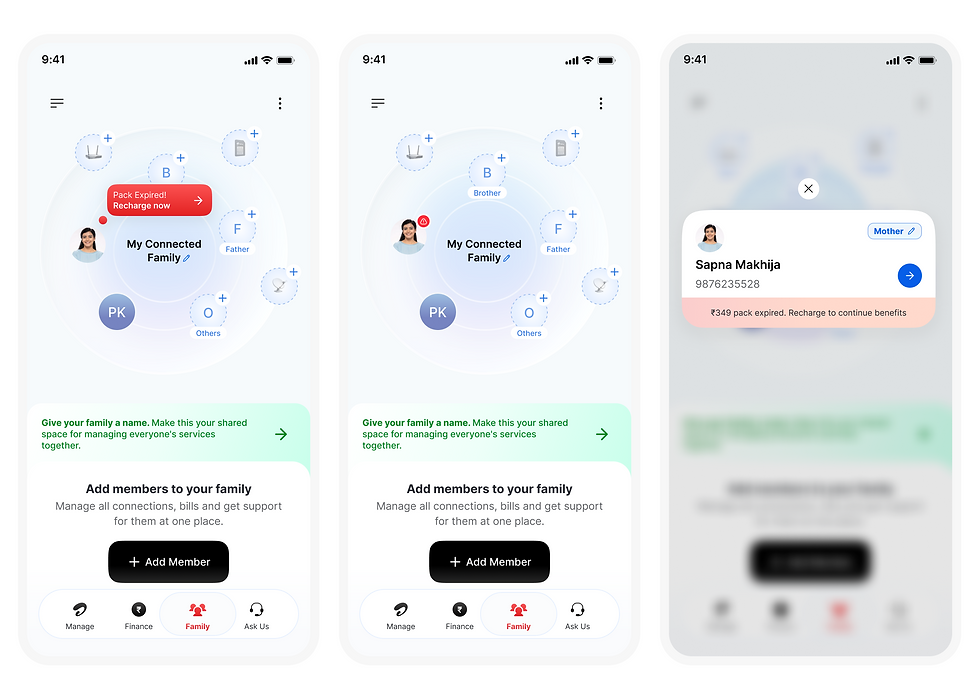
I designed Family Mode as a single place where the primary account holder could add family members and manage their connections without switching between accounts—from recharges and bill payments to service requests and support. But the research also showed that managing a household doesn't stop at Airtel connections, so we extended the experience to include FASTag and home electricity payments.
The key shift wasn't putting a “family” label on existing journeys. It was changing the underlying model from “manage my account” to “manage the people and services I'm responsible for.” That meant the household became the organising principle, with actions consolidated around the people and connections that mattered to the customer.
Family Mode is still being scaled, but the early signals are encouraging. In deep-dive user sessions, customers are actively adding family members, and recharge activity through Family Mode is already higher than through the individual flow it replaced.
Travel Mode
Travel Mode started from a similar instinct, applied to a completely different situation: what does a customer actually need once they've bought an international roaming pack?
The existing experience was product-led. You bought a pack, and then you were largely on your own—navigating separate journeys for roaming, data usage, and support. I reframed it around the travel experience rather than the product: not “here's the pack you bought,” but “here's everything you need to stay connected while you're away.”

Travel Mode — before departure
That meant designing for the customer's journey across three moments: before departure, during the trip, and after landing. The deeper problem wasn't just navigation—it was anxiety. When you're abroad, not knowing how much data you're using, what something will cost, or what to do when connectivity stops working creates a very different kind of stress. And unlike at home, getting help isn't always straightforward.
Travel Mode was designed to make those uncertainties visible and actionable: what's active, what you're using, what it might cost, and what to do when something goes wrong.
The experience is now live for 100% of prepaid customers and is scaling to postpaid, currently at around 30%. It has also become a meaningful business lever: approximately ₹6 crore in incremental monthly revenue, around 1 lakh daily visitors, and a measurable increase in revenue captured among customers who use Travel Mode compared with those who don't.
My Role
Family Mode and Travel Mode were part of the broader Next Gen Airtel App redesign I led as Senior Design Lead, alongside a team of five designers and the design-system team. That larger body of work—including the app vision, Next Best Action, and category landing pages—is covered in a separate case study.
These two projects were different. I designed both solo, end-to-end, owning the work from initial concept and flows through to the final screens, with no team handoff. Each took a little over two months from start to finish.


